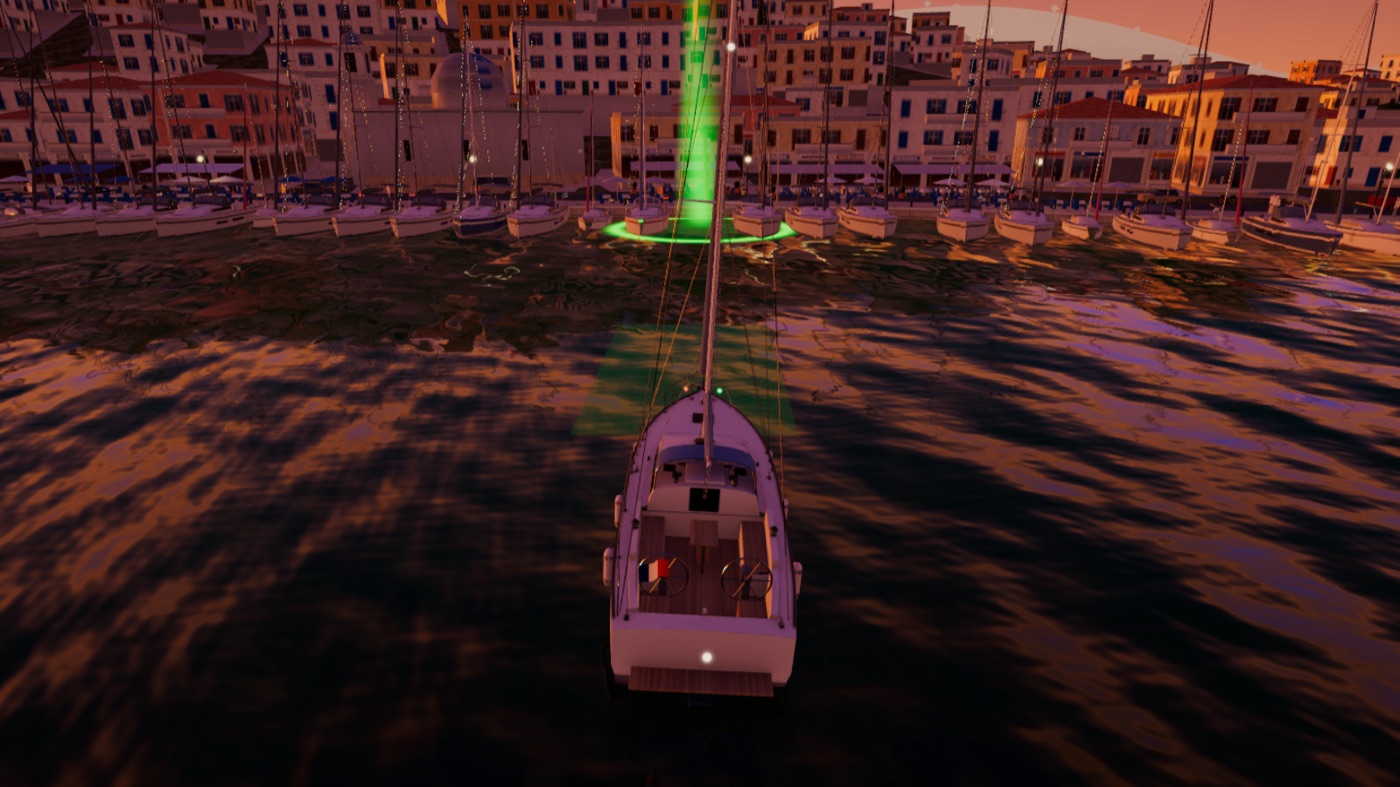
The plan, step by step
Arriving
Prepare and pick your berth
Fenders on both sides, a little higher than for a pontoon, plus a roving fender. Two stern lines ready, gloves and boathook to hand. Motor along the row at tickover and slow down as you reach the berth.
HelmLine up, bow slightly to windward
Pivot the boat to bring the stern facing the berth, about a boat length from its entrance. Leave the bow slightly to windward: the wind will push it while you go astern.
HelmGo astern with momentum
Slow astern, started early enough to give you a long run in: the rudder only steers with speed, and prop walk has to be corrected before you get in. Neutral between the neighbours, then a short burst ahead to stop near the quay.
HelmWindward line first
The windward stern line goes ashore first and is kept a little slack. If nobody is ashore, step off with a single stride; never jump.
Stern crewLead the lazy line forward
Wearing gloves, pick up with the boathook the lazy line that comes from the quay in the middle of your berth. Haul it hand over hand outside the guardrails and make it fast on the bow cleat. Then get the leeward stern line ashore.
Bow crewTension and adjust
Haul the lazy line tight: it is what stops the stern hitting the quay. Adjust the stern lines to lie about a metre off the quay (some prefer 1.5 to 2 m) while still being able to get ashore. Put out the passerelle.
Whole crew
Leaving
Get ready to leave
With the engine running, check that no line is trailing around the boat or the dinghy. Note where the wind is coming from: the leeward lines are let go first.
HelmReturn the lazy line to the water
Let the lazy line go from the cleat and lower it gently along the side; don’t throw it. Call out “lazy line gone”.
Bow crewWait for it to sink
Ahead at tickover to stay off the quay, and wait for the lazy line to reach the bottom, about a minute. Otherwise the propeller picks it up.
HelmLet go aft, leave straight
Let go the leeward line, then the windward one. Motor out straight and slowly, helm amidships, and only turn once the stern is clear of the neighbours.
Stern crew
Who does what
On the helm
Chooses the angle of approach according to the wind and prop walk, goes astern slowly, stops the boat with the engine and holds the distance off the quay while the bow is being worked. Never leaves the helm.
Stern crew
Calls the distance to the quay, gets the windward line ashore and then the leeward one, or hands them to the person ashore. Adjusts their length at the end.
Bow crew
Wearing gloves, with the boathook, picks up the lazy line near the quay, leads it up to the bow cleat and takes it up tight. When leaving, lets it go and lets it sink.
Ashore (marinero, neighbour)
Often someone takes your lines or hands you the lazy line. Listen to what they tell you: they know the berth.
The dangers
The lazy line round the prop
Going astern near the quay, or when leaving if it is still floating, the lazy line gets sucked into the propeller. Neutral as the stern passes over it; when leaving, wait until it is on the bottom.
Cut hands
The lazy line is covered in mud, weed and sharp shells. Always wear gloves.
Fingers between line and cleat
A line under load crushes fingers. Take a turn round the cleat before you pull, and never put your hand in the loop.
Jumping ashore
The boat is still moving and the quay is hard. Step off with a single stride when the stern is very close, or throw the line to someone.
A slack lazy line
At the first gust or with the swell at night, the stern comes back and hits the quay.
Common mistakes
- Picking up the neighbour’s lazy line. Almost all of them are underwater. Yours comes from the quay in the middle of your berth, or from a small buoy in front of it.
- Pulling the whole lazy line on board. You end up dragging the neighbours’ lazy lines. Only pull the part that runs forward, not the part that leads back to the quay.
- Going astern too fast. It causes most harbour accidents. Between two boats, go slower than you think you need to.
- Forgetting prop walk. As soon as you engage astern, the stern kicks to one side. Try your boat in astern in open water before entering a busy harbour.
- Dropping your anchor among the lazy lines. It hooks the ground chain; sometimes it takes a diver to free it.
- Throwing the lazy line overboard when leaving. It floats for a while and ends up round the propeller. Lower it gently back into the water.
- Following an order learnt by heart. Opinions differ on which line goes on first: most say the windward stern line, others the lazy line first, especially in strong winds. If the marinero asks for the lazy line first, do as he says.
Depending on the wind
- Crosswind. The most common case in the Mediterranean. Come in with the bow slightly to windward, get the windward stern line on first, then hold the bow with a touch of ahead, helm to windward, while the lazy line is picked up. If the leeward neighbour is lying over your berth, lean gently on the windward neighbour with a big fender.
- Wind from astern (off the quay). The easiest: you go astern into the wind and the boat holds her line, like a weathervane. The wind slows the boat; judge the astern accordingly.
- Headwind (towards the quay, from seaward). The wind pushes the stern towards the quay throughout the manoeuvre. The lazy line has to be tightened quickly. If it is too strong, some advise going in ahead, bows to the quay.
- Strong wind. Many marinas send someone out in a RIB to push the boat into place. Ask for it on the VHF. If the manoeuvre starts to go wrong, back out and start again: far better than forcing it.
Local customs
- France: in the Mediterranean, most harbours have lazy lines attached to a ground chain on the bottom, and you moor stern-to. Where there are none, your anchor holds the bow.
- Spain: mooring on a muerto (lazy line), stern or bows to the quay, is the most common. In the Balearics, the lazy line is not always doubled. If the berth is too awkward, ask the marinero for another one.
- Italy: in marinas, an ormeggiatore often comes out in a gommone (RIB) to guide you to the berth; call him on the VHF before entering.
- Croatia: you almost always moor stern-to, on a lazy line. The marinero, often in a dinghy, shows you the berth, or waves you in from the quay. Call him on the VHF, channel 17 or 16 depending on the marina.
- Greece: in marinas, someone ashore often hands you the lazy line; have a crew member ready. On public quays, you usually lay your own anchor (see the guide to mooring stern-to on your anchor).
- Turkey: in marinas, staff in a RIB help place the boat and pass the lines. If you are alone on board, say so: they sometimes send two marineros, one for the lazy line, one for the stern lines.
On the VHF
“Marina, this is sailing yacht Alcyone, eleven metres. Request a berth for one night, stern-to. Over.”
See also

Practise it
Level 7 · Marseille
Do this manoeuvre again in the app, as many times as you need, without scratching a hull.