The plan, step by step
Arriving
Prepare and approach
Fenders on both sides, two bow lines ready at the bow, a long stern line with its buoy hook, led to a winch. Approach at tickover, at walking pace.
Whole crewPass close to the buoy
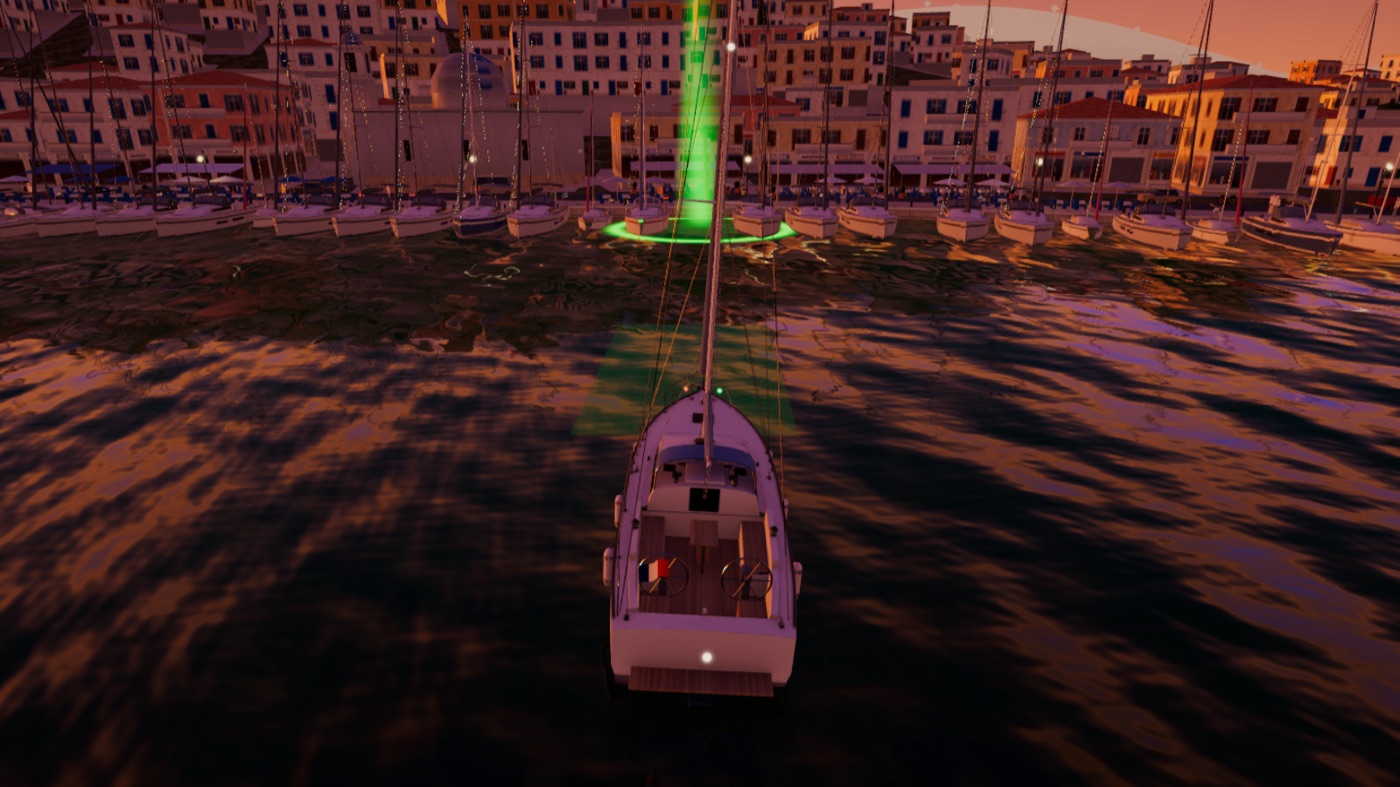
Choose a berth whose buoy is free, ideally in line with the berth or a little to windward. Pass very close to it, leaving it to windward; the crew, amidships, hooks it as it comes level.
Helm and cockpit crewMotor in paying out the line
The boat carries on slowly towards the pontoon. The buoy line pays out while kept slightly taut: without tension, the hook can drop off the ring.
Helm and cockpit crewStop half a metre off
Slow down about 5 m before the pontoon, then a short burst of astern stops the bow about half a metre off. Never stop the boat by hand, by foot or with the boathook.
HelmBow lines in a V
The crew steps off over the bow (by the bow ladder if the boat has one) and makes the windward bow line fast first, then the second: two lines in a V stop the bow swinging sideways.
Bow crewTake up the buoy line
Take up the slack in the stern line so the bow stays clear of the pontoon. The boat is held between the buoy and the pontoon.
Cockpit crew
Leaving
Start the engine first
The engine is running before the first line is let go. The evening before, you can rig the buoy line on a slip so it can be let go from on board.
HelmKeep one bow line
Let go the leeward bow line and keep the windward one, short or on a slip, to hold the bow while the buoy is dealt with.
Bow crewLet go the buoy
Let go the buoy line and bring it on board straight away. In a crosswind, first bring the buoy round behind the transom, to the windward side, if the berth allows.
Helm and cockpit crewGo astern out of the berth
Let go the last bow line, or bring it in on a slip, and go astern at tickover. No line must trail in the water near the propeller.
Helm
Who does what
On the helm
Chooses the berth and which side to leave the buoy, works the throttle, calls each stage. This is the job for the most experienced person.
In the cockpit (buoy)
Hooks the buoy on the way past, pays out the line round the winch keeping a little tension on it, then takes it up at the end.
At the bow
Prepares two bow lines, guides the helm with hand signals on the distance to the pontoon, steps ashore and makes the windward line fast first.
The dangers
The buoy line round the prop
The stern line is long: the buoy is often 20 m or more from the pontoon. Slack trailing astern, when stopped or when leaving, goes into the propeller. A floating line reduces the risk.
A foot or hand between bow and pontoon
Never brake the boat by pushing off the pontoon with a hand, a foot or the boathook: the risk of injury is high. The engine stops the boat.
Stepping off a high bow
On a floating pontoon, the bow of a modern cruiser is well above the pontoon. Step off in good shoes, holding on, by the bow ladder if there is one, once the boat has stopped.
A crosswind pushes you onto the neighbour
As soon as the buoy line is on, a crosswind pushes the boat onto the leeward neighbour. Fenders on both sides, and be ready to go round again if the approach goes wrong.
Common mistakes
- A buoy line that is too short. Buoys are often a long way from the pontoon. With 10 m, you can find yourself brought up short before reaching the pontoon: allow more.
- Taking two buoys. In Sweden, the custom is one buoy per boat. Taking two means taking someone else’s berth and making it harder for everyone to leave.
- Leaving the line slack on the approach. An open hook only stays in the ring through its own weight and the tension in the line. Without tension, it drops off and the buoy is lost.
- Ignoring prop walk when leaving. Going astern, the stern swings one way and the bow the other. One Swedish sailor advises keeping the buoy on the side the bow swings towards.
Depending on the wind
- Crosswind. Opinions differ. Most advise leaving the buoy to windward: it is what holds the stern. Others find that a buoy to leeward helps you stay perpendicular to the pontoon. In strong winds, brake when the buoy is halfway along the boat and hook it as the stern reaches it. You can also take a bow line to the windward neighbour.
- Leaving, buoy to leeward. Windward bow line on a slip, ease it until the buoy is behind the transom, then go astern at tickover, letting go the buoy. Another method: let go the buoy first, let the boat swing head to wind on a short bow line, then let that go and go astern.
- Full harbour. You can slip in between two boats already moored: they stop you drifting. A short line to their cleats helps while the bow lines go on.
- In the islands, with no buoy. In small harbours and anchorages in the Swedish archipelago, a stern anchor often replaces the buoy, dropped two to three boat lengths before reaching the rocks. Finish dead slow, with at least two long bow lines of 20 to 30 m.
Local customs
- Sweden: bows to the pontoon is the most widespread way of mooring in northern Europe; one buoy per boat. Many Swedish yachts also carry a stern anchor for the islands.
- Sandhamn (KSSS): in the basin below the Seglarhotellet, the berths have lines attached to the pontoon and to a chain on the bottom; anchoring is prohibited. In high season, the club tender guides boats in: contact it, or a harbour officer, before mooring.
- Finland: you pick up the buoy in line with the berth or a little to windward, and hold the bow with two lines in a V.
- Norway: some guest harbours have buoys for the stern with the bow to the quay, such as the outer basin at Åsgårdsstrand, in the Oslofjord.
- Denmark: accounts differ. For some, it is mostly box berths between piles; for others, bows to the pontoon with the stern on buoys.
On the VHF
“Harbour office, this is sailing yacht Alcyone. Request a visitor’s berth for one night, eleven metres, bows-to with a stern buoy. Over.”
See also

Practise it
Level 15 · Sandhamn
Do this manoeuvre again in the app, as many times as you need, without scratching a hull.