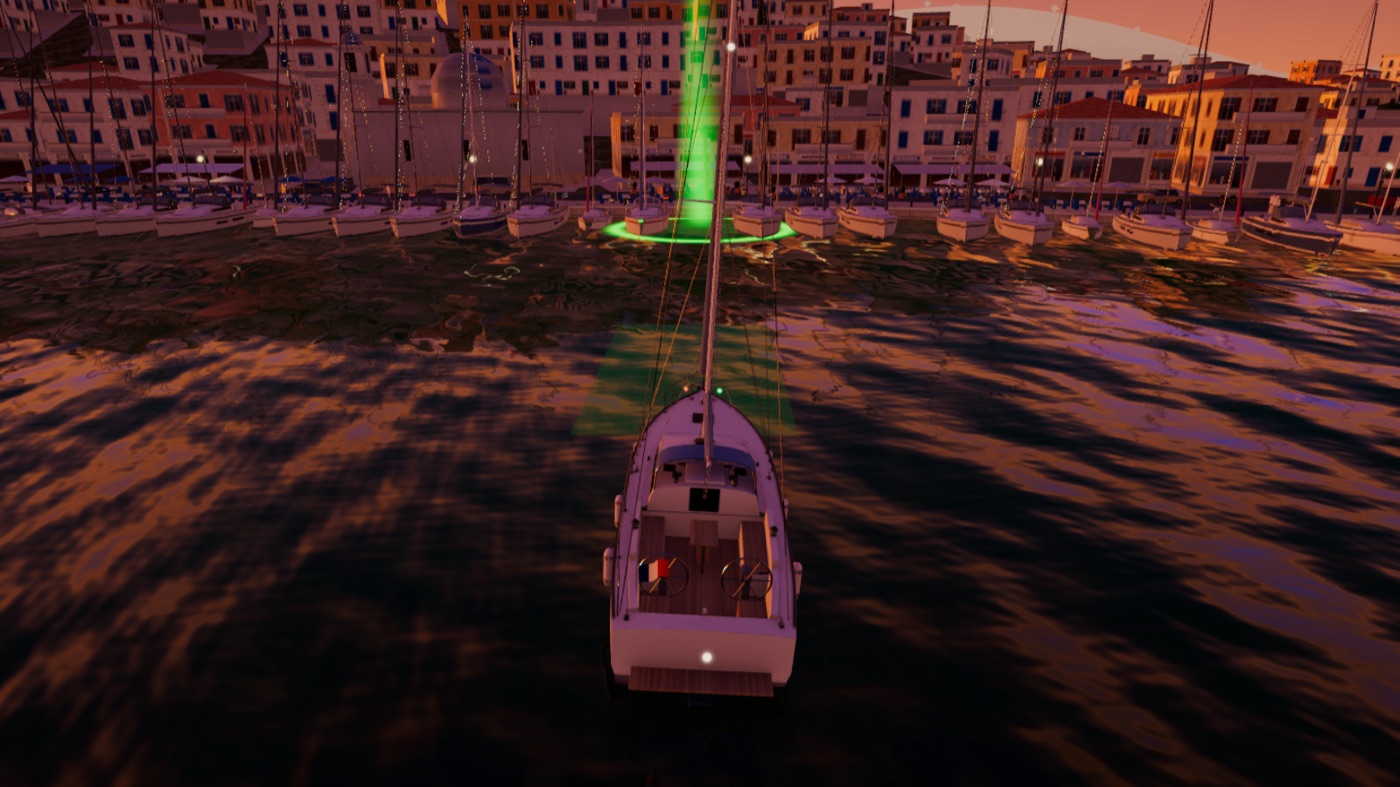
The plan, step by step
Arriving
Pick your berth
At tickover, motor past the row, staying seaward of the spot where you will drop the anchor. Look at the free width, the depth on the sounder and which way the neighbours’ chains run: usually straight out to sea.
HelmLine up, bow to seaward
Position yourself on the line of the berth, at right angles to the quay, bow to seaward, a little beyond the spot where you will drop. In a crosswind, offset a little to windward of the berth.
HelmGather sternway, then drop
Gather way in slow astern. About four boat lengths from the quay (at least 40 m for an 11 m boat), the helm gives the signal: the anchor goes down and the chain pays out as soon as the boat is moving astern.
Helm and windlassGo astern paying out chain
Keep enough way to steer. At the windlass, pay out at the boat’s pace, smoothly: too slowly and the anchor is dragged; too fast and the chain no longer holds the bow. The helm corrects for prop walk and the wind.
Helm and windlassStop paying out a boat length off
About a boat length from the quay, stop paying out: the chain tightens, the anchor digs in and brakes the boat. If you can’t go astern any further, pay out a little more chain.
WindlassLines ashore, windward first
Neutral for the last few metres. About a metre from the quay, the windward line goes first, then the leeward one, to a crew member who has stepped ashore without jumping, or to someone on the quay.
Stern linesTake up the chain
Take up the chain on the windlass and adjust the lines to keep the stern clear of the quay: ferry wash lifts the boats. Then put out the passerelle.
Windlass and linesCheck the anchor is holding
Once the lines are made fast, and only if nothing is trailing in the water, go astern: the chain should come almost bar-tight. If you bring in a lot of chain without it tightening, the anchor hasn’t set: start again.
Helm
Leaving
Look at the chains around you
Before leaving, work out where the neighbours’ chains run. Ideally, boats leave in the reverse order of arrival. Brief the crew and agree on hand signals: the windlass drowns out voices.
Whole crewLet go the leeward line
With the engine in neutral, bring in the leeward line first. Keep the windward one: it holds the stern while the bow starts to come up to the anchor.
Stern linesHeave in, motoring ahead at tickover
Let go the windward line, bring it in without letting it trail in the water, and motor ahead at tickover while the chain comes in. At the bow, the crew points to show which way the chain is leading; it should stay almost vertical.
Helm and windlassIf another chain comes up with the anchor
Neutral, no propeller. Pass a line under the neighbour’s chain, make it fast on board, pay out a little of yours to free the anchor, then let go the line so the neighbour’s chain drops back quickly.
WindlassClear the row
Anchor stowed, motor straight out to sea, allowing for the wind pushing you down onto the neighbours’ bows.
Helm
Who does what
On the helm
Chooses the line and the dropping spot, judges the astern, gives the signals. The helm stops the boat, not a long burst ahead.
On the windlass
Drops on the signal, pays out at the boat’s pace, stops paying out a boat length from the quay, then takes up the chain. When leaving, guides the helm with hand signals.
On the stern lines
Prepares two coiled lines at the stern, long enough to be rigged on a slip, and fenders on both sides and on the transom. Steps ashore or hands the lines to someone on the quay.
The dangers
Fingers in the chain
Never use your fingers to free a chain jammed in the windlass.
A line round the prop
Lines coiled on a winch, out of the water. No propeller in the last few metres, nor when leaving while a line is trailing, and no long burst ahead near the quay.
Your anchor over a neighbour’s chain
Dropped at an angle or too close to another, your anchor lands on its chain. When leaving, one of the two boats lifts the other’s anchor.
The transom against the quay
Ferry wash moves the boats on the quay; at Poros, a sudden storm damaged many boats in 2016. Keep your distance, a big fender on the transom and a well-set anchor.
Jumping onto the quay
The crew steps off when the stern is close enough, without jumping.
Common mistakes
- Dropping too close to the quay. Not enough chain on the bottom: the anchor doesn’t set, or breaks out as soon as the chain is tensioned.
- Dropping at an angle. A chain that doesn’t run straight out to sea crosses the neighbours’ chains.
- Stopping paying out on the way in. The chain snubs the bow, the boat loses way and no longer steers; with a crosswind, she ends up beam-on.
- Pulling too hard on the chain. Too much tension while going astern pulls the anchor out before it has set.
- Shouting. The windlass drowns out voices, and shouting makes things worse. Agree on signals in advance, call each person by name, give orders slowly.
- Practising in a full harbour. The first time, try it in an empty harbour or out of season: you learn how the boat goes astern and stops.
Depending on the wind
- Crosswind (meltemi). Drop a little to windward of the berth and pay out as much chain as you can; the tight chain stops the bow blowing off. Keep more power in astern, fenders on the leeward side, and have a long line ready to take to windward as soon as you can. If you are blown off your line, motor out and start again.
- Wind off the quay. You are going astern into the wind: the helm leads, using astern, while the windlass pays out.
- Wind from seaward (pushing you onto the quay). An ordinary anchoring: the windlass leads, the anchor holds the bow to the wind. Stop paying out a boat length off so the anchor sets before the transom gets near the quay.
- Strong crosswind when leaving. Take a long spring to windward, on a slip round a bollard, and ease it while the windlass hauls the boat forward, until you are clear of the neighbours.
Local customs
- Greece: many harbours are simple town quays where the bow is held by your own anchor, with no lazy lines. You often pay someone who comes round in the evening or the morning.
- Greece: neighbours often help take your lines. Some skippers don’t leave their own boat until both their neighbours are moored.
- Poros: on the north-west quay you drop in about 10 m of water (have plenty of chain), on the south quay in 5 to 6 m, with good holding in mud. Ferry wash is almost constant: keep the stern well off the quay. A no-anchoring zone off the town was reported in 2026.
- Greece, in summer: the meltemi often blows force 4 to 6, sometimes 7 to 8 for several days; it gets up in the morning and blows hardest in the afternoon.
- Turkey: on some town quays (Çeşme, Kalkan), you moor stern-to on your own anchor; the harbourmaster helps with the lines or shows you the berth. At Kalkan, the gulets’ chains often run across the harbour.
- Croatia, Italy, Spain: marinas and many quays have lazy lines. Crews used to them have to change their method on Greek quays.
On the VHF
Channel 12Poros Coast Guard
“Poros Coast Guard, this is sailing yacht Alcyone, eleven metres. We are entering the harbour to berth stern-to on our own anchor on the north-west quay. Over.”
See also

Practise it
Level 13 · Poros
Do this manoeuvre again in the app, as many times as you need, without scratching a hull.